
Kitchen · How-to · Updated November 2026
How to Care for a Chef Knife: Honing, Sharpening and Storage
A good knife stays sharp for years with three habits: hone it often, sharpen it when honing stops working, and store it so the edge never bangs into anything. Here is the short, practical version.
In 30 seconds
- After every use: wash by hand, dry right away, store it safely.
- Every week or so: a few light strokes on a honing rod.
- Once or twice a year: sharpen on a whetstone or a sharpener, or have it sharpened.
- Never: the dishwasher, a glass or stone board, or loose in a drawer.
Is your knife dull? Three quick checks
- The tomato test: a sharp knife bites into the skin with almost no pressure. If it slides or squashes the tomato, the edge needs attention.
- The paper test: hold a sheet of printer paper by one corner and slice down through it. A sharp edge cuts cleanly; a dull one snags or tears.
- The light test: look straight down at the edge under a bright light. A sharp edge is almost invisible. Shiny spots or a thin bright line mean the edge is rolled or worn there.
If a few strokes on a honing rod fix it, the edge was only bent. If nothing changes after honing, it is time to sharpen.
Honing vs. sharpening: what's the difference?
Honing straightens the thin edge of the blade, which bends slightly with everyday use. It removes almost no metal and takes about 20 seconds. Sharpening grinds away a little steel to create a new edge. You hone often and sharpen only when honing stops helping.
How to hone a knife
- Hold the honing rod upright with its tip on a stable, non-slip surface, such as a folded towel on the counter.
- Place the heel of the blade against the top of the rod at roughly 15 to 20 degrees. Many Japanese-style knives are ground at the lower end of that range.
- Draw the blade down and across the rod in one smooth motion, finishing at the tip.
- Repeat on the other side. Five or six light strokes per side are plenty.
- Wipe the blade clean before you cut.
How to sharpen with a whetstone
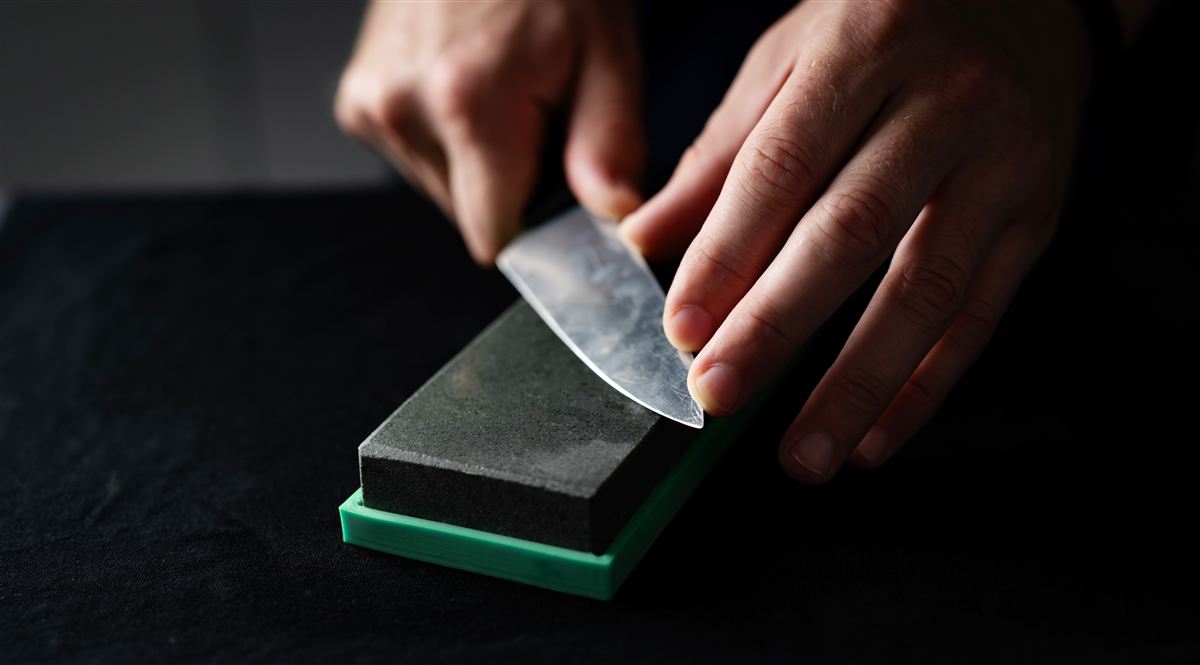
A water stone gives the most control, and it is easier than it looks. Most home cooks do well with a combination stone.
- Grit: around 1000 grit to restore a dull edge, and 3000 to 6000 grit to refine it. Below 400 grit is only for repairing chips.
- Prep: soak the stone as the maker instructs, and sit it on a damp towel or a stone holder so it can't slide.
- Angle: keep a steady 15 to 20 degrees. A common trick is to picture two or three coins stacked under the spine of the blade.
- Motion: push the edge across the stone from heel to tip with light pressure, and keep the stone wet. Work one side until you feel a thin burr along the edge, then flip and do the other side.
- Finish: switch to the finer grit for a few strokes per side, then hone and rinse the blade.
Which sharpening tool fits you?
| Tool | Best for | Trade-off |
|---|---|---|
| Honing rod | Keeping a sharp knife sharp between sharpenings | Does not fix a truly dull edge |
| Whetstone | The most control, and good Japanese-style knives | Takes practice and a few minutes |
| Pull-through sharpener | Fast, easy results with no skill needed | Removes more steel, less control over the angle |
| Electric sharpener | Several knives, done quickly | Costs more and can take off a lot of metal |
| Guided or rolling sharpener | A steady angle without freehand skill | More parts to set up |
Next · Pick your sharpener
Compare rods, stones and sharpeners side by side
Our knife sharpener guide groups the options by type, with approximate starting prices and what to check before you buy.
Daily care that makes the biggest difference
- Wash by hand with warm water and mild soap, then dry right away. Dishwashers are rough on edges, handles and finish.
- Cut on wood or soft plastic. Glass, stone, marble and ceramic boards dull a blade quickly. Compare wood, plastic and bamboo boards.
- Don't pry, twist or chop through bone. Thinner blades can chip. Use a heavier knife or a cleaver for that.
- Wipe acidic foods such as lemons, onions and tomatoes off the blade soon after cutting, especially on carbon steel.
- Never leave it in the sink. That is how the edge gets damaged, and how people get cut.
Where to store a knife
Loose in a drawer is the worst option, because the edge bangs against other tools. Better choices are a magnetic strip on the wall, a countertop block, a drawer tray with slots, or a blade guard (a sheath). Whichever you choose, make sure the blade is dry first. Many knife sets come with their own block, which solves storage in one go: see the sets in our kitchen knife guide.
Stainless or carbon steel: does care change?
Stainless steel resists rust and forgives a missed wipe. Carbon steel can take a very fine edge but will develop spots or a gray patina if left wet, so it needs drying every time. Neither type likes long soaks.
When is it time for a new knife?
A knife is worth replacing when the tip or edge has large chips, the blade is bent, the handle is loose or cracked, or it no longer holds an edge for more than a few days after sharpening. If you are choosing one now, start with how you cook:
Quick questions
How often should I sharpen a kitchen knife?
For most home cooks, once or twice a year, plus honing every week or so. If you cook every day, you may need to sharpen a little more often.
Can I sharpen a Japanese knife on a pull-through sharpener?
Only if the sharpener's angle matches the knife. Many Japanese-style knives are ground at around 15 degrees, and some pull-through sharpeners are set for a wider angle. Check the knife maker's instructions first.
Is a honing rod the same as a sharpener?
No. A honing rod straightens the edge; a sharpener grinds a new one. You need both over the life of a knife.
Have you tested these tools?
No. This is a general guide based on common kitchen-knife practice, not a hands-on review.
General information based on common kitchen-knife practice. Always follow the care instructions from your knife's manufacturer, and cut away from your fingers.